

Retail arbitrage is the simplest way to start selling on Amazon: buy products cheaply in ordinary UK shops, then resell them on Amazon at the higher price they sell for online. The gap between the shelf price and the Amazon price — minus Amazon's fees — is your profit. No inventing products, no importing from China, no warehouse. Just spotting price gaps that exist every day in Tesco, B&M, Boots and Home Bargains.
Retail arbitrage (RA) means buying discounted or clearance stock from retail shops and reselling it on Amazon for profit. It's legal in the UK under the exhaustion-of-rights principle — once a genuine product is sold, the buyer can resell it. A typical flow: scan a product's barcode in-store, check what it sells for on Amazon, subtract Amazon's fees and your cost, and buy only when the numbers clear your targets (many sellers use 30% ROI and £3+ profit per unit). The skill isn't finding products — it's checking the numbers before you buy.
On this page
Retail arbitrage, defined
The word "arbitrage" just means profiting from a price difference between two markets. In retail arbitrage the two markets are a physical shop and Amazon.co.uk. A face cream on clearance at £5 in-store might sell for £13.94 on Amazon. After Amazon's cut, that can be a real profit — or a loss dressed up as one, which is why the maths matters more than the hustle.
Retail arbitrage's close sibling is online arbitrage — same idea, but sourcing from websites instead of physical shops. And it's different from wholesale (buying in bulk from distributors) and private label (creating your own product). RA is where most UK sellers start because the risk per decision is a few pounds, not a few thousand. If you want the step-by-step setup, that's our beginner's guide to starting retail arbitrage in the UK — this article is about understanding how the model actually works.
The model works because high-street clearance and Amazon pricing move independently. A supermarket resets its shelves seasonally and marks stock down to clear space; Amazon's price is set by competition between sellers and rarely follows the high street down. That disconnect appears and disappears daily across thousands of products — which is why arbitrage sellers talk about "sourcing trips" rather than one-off finds, and why the same Boots clearance aisle can be empty of opportunities one week and full of them the next.
Is retail arbitrage legal in the UK?
Yes. Under UK and EU law, once a genuine product has been placed on the market by the brand or with its consent, the trademark owner's rights are "exhausted" — the buyer may resell it. You must sell genuine goods, describe them accurately, and comply with consumer law, and some brands and categories are gated on Amazon (you need approval to list them). Gating isn't a legality issue — it's Amazon's own permission system, and checking it before you buy is part of the routine.
How retail arbitrage works, step by step
The whole model runs on one loop, repeated:
- Find a candidate. Clearance aisles, promo ends, seasonal resets — anywhere a shop discounts genuine stock.
- Scan the barcode. This matches the product to its Amazon listing.
- Read the demand. How fast does it sell (Best Sellers Rank, estimated monthly sales)? How many sellers share those sales?
- Run the profit maths. Amazon price − referral fee − FBA fulfilment fee − VAT − your cost = net profit.
- Check the risks. Is Amazon itself on the listing? Is the price about to fall? Is the brand gated for you?
- Decide: buy, skip, or watch. Only buy when the numbers clear your rules.
- Send stock to Amazon (FBA) and repeat with the next product. (New to FBA? See how Amazon FBA works.)
Steps 2–6 used to mean juggling Keepa charts, a fee calculator and a spreadsheet in the middle of an aisle. A scanning app does them in one screen. Here's what that actually looks like on a real product.
Where do UK sellers actually source?
Any shop that discounts genuine branded stock can work, but a few patterns repeat. Discounters like B&M, Home Bargains and Poundland stock branded goods at permanently lower prices than Amazon's marketplace level. Supermarkets — Tesco, Morrisons, Sainsbury's, Asda — run deep clearance on seasonal resets, typically January and late summer. Boots and Superdrug clearance is a classic source for beauty and skincare, the exact category in the scan below. And "3 for 2" or multibuy promotions can quietly push a product below its MAX PAY threshold even when the single-unit price doesn't.
The common thread: you're not looking for special products, you're looking for ordinary products at temporarily silly prices. That's also why the checking discipline matters — the shelf tells you the price, but only the numbers tell you whether it's a deal.
A real scan, from shelf to decision
We scanned a L'Oréal skincare product at £5 on promotion. Here's the read, screen by screen.
The 60-second decision screen
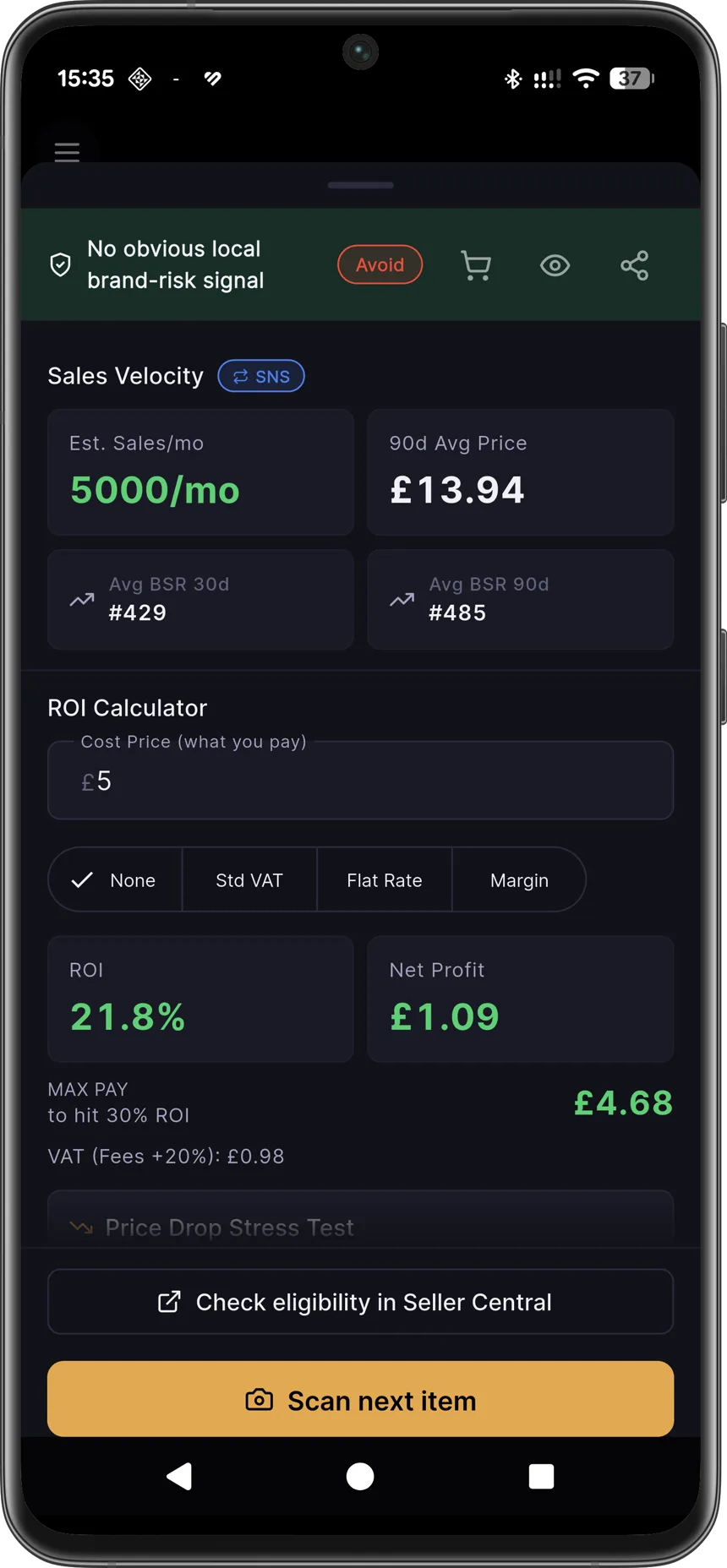
The top of the result answers the two questions that matter: does it sell, and does it pay? Estimated sales of ~5,000/month and a Best Sellers Rank in the hundreds say demand is strong. At a £5 cost, ROI shows 21.8% and net profit £1.09 — real numbers, after fees. The MAX PAY figure (£4.68) is the most useful one in the shop: it's the most you could pay for this item and still hit a 30% ROI target. Shelf price above MAX PAY? You already have your answer.
The numbers behind the verdict
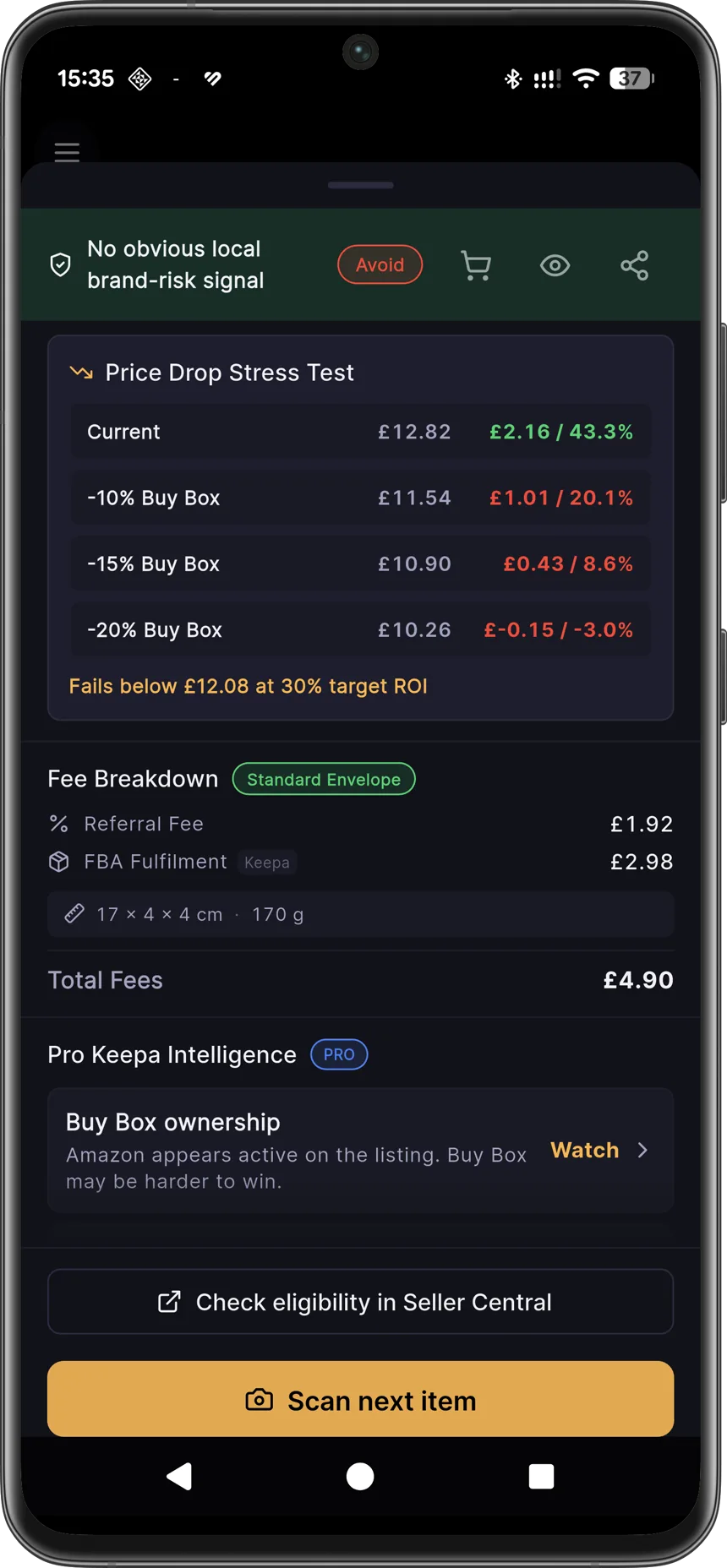
Tap deeper and you see why: Amazon's referral fee (£1.92), the FBA fulfilment fee (£2.98, based on the item's size and weight), £4.90 in total fees on a ~£13 sale. The Price Drop Stress Test asks the question beginners forget: what if the Amazon price falls after you buy? At the current £12.82 the deal makes £2.16; a 10% Buy Box drop cuts profit to £1.01; at −20% it's a 15p loss. This product fails below £12.08 — thin protection. (Fees are the making or breaking of every RA deal — the full picture is in Amazon FBA fees UK, explained.)
Reading demand and competition
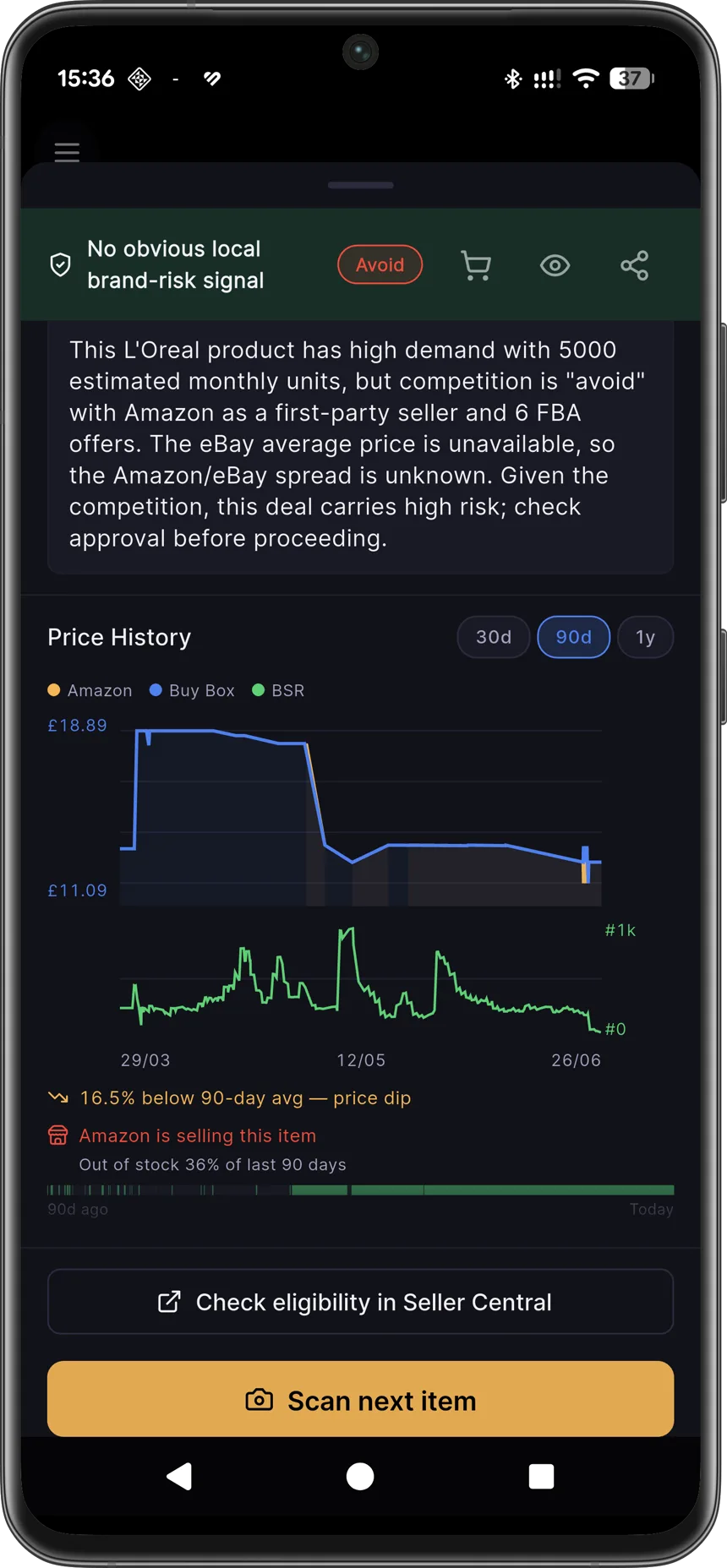
The price-history chart is the lie detector. This one shows the price dropped from ~£18.89 to ~£12.82 over 90 days — today's "profit" is measured against a price 16.5% below its own average, and the BSR line confirms sales continue at the lower price. The AI summary then says the quiet part out loud: Amazon itself is a seller on this listing and there are 6 FBA competitors. When Amazon is on a listing, winning the Buy Box is hard; combined with the falling price, this deal carries real risk despite the healthy demand.
When the app says walk away
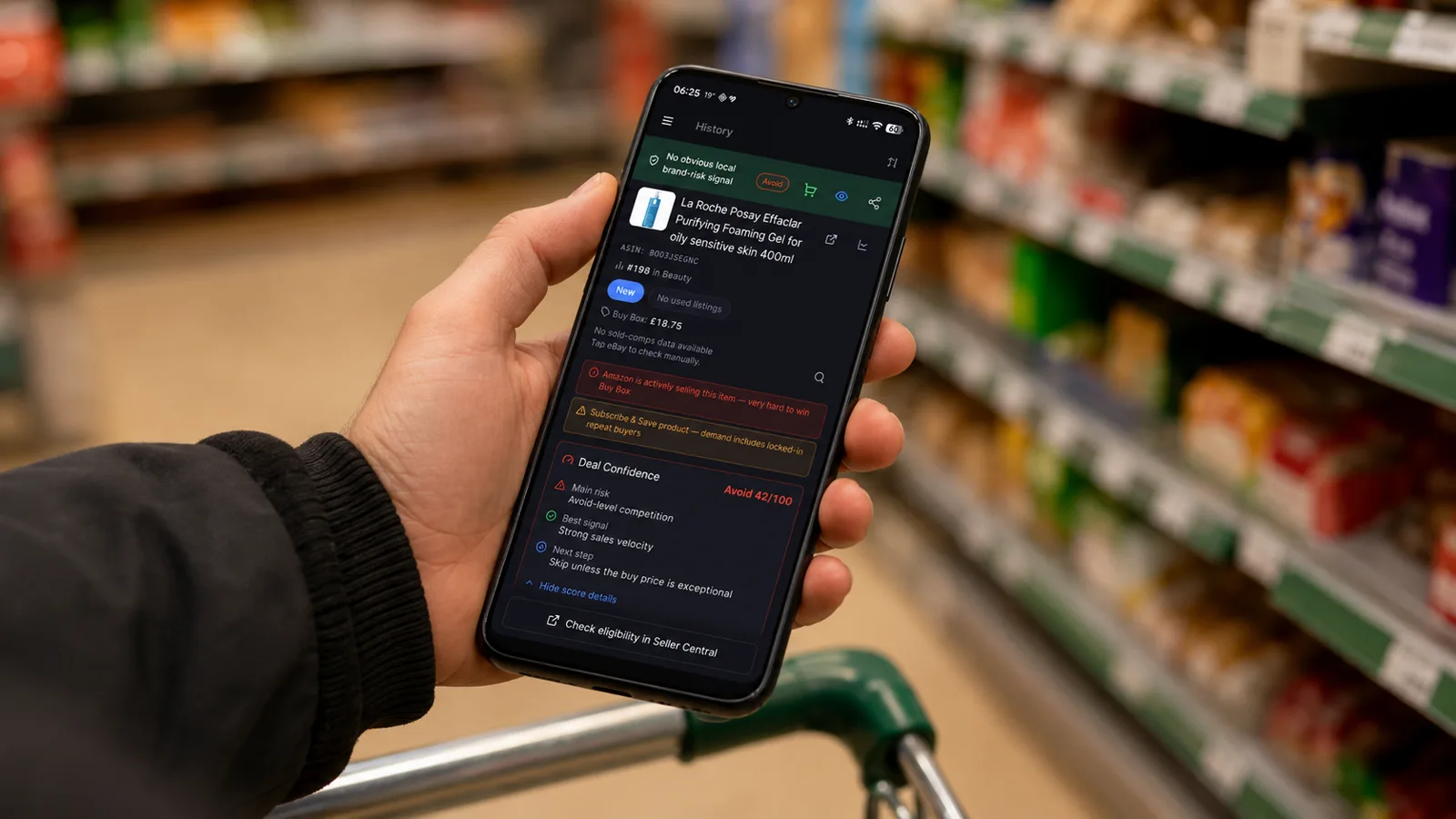
This is the part no one shows in the "I made £10k a month" videos: most scans should end in a no. Here the verdict is explicit — Avoid, 42/100 — main risk: avoid-level competition; next step: skip unless the buy price is exceptional. A disciplined RA seller treats "avoid" as a win: it's a £5 mistake you didn't make, found in 60 seconds. This honest filtering is the actual skill of retail arbitrage — margin protects you, but selectivity is what makes the model work. (More on realistic expectations: is retail arbitrage still worth it in the UK?)
It's worth understanding why this particular product fails despite selling ~5,000 units a month. First, Amazon is on the listing as a seller — when Amazon competes for its own Buy Box, third-party sellers win it rarely and usually only by cutting price. Second, it's a Subscribe & Save product, meaning part of that headline demand is locked into repeat deliveries you'll never compete for. Third, the price has already fallen 16.5% below its 90-day average — you'd be buying into a falling market. Any one of these is survivable; all three together is how sellers end up with fifty units they can't sell at break-even. Sixty seconds of checking beats three months of storage fees.
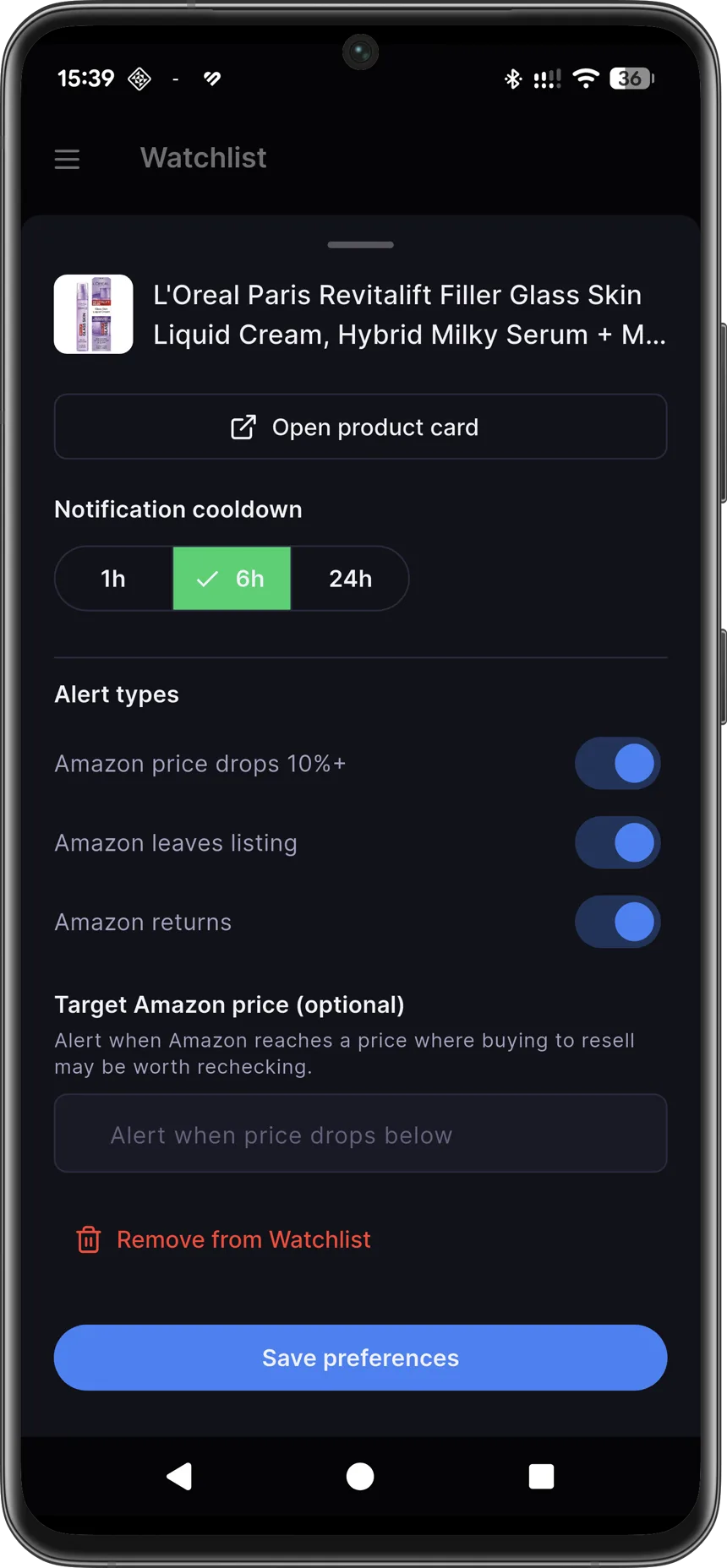
Walking away doesn't have to mean forgetting. Adding a product to a Watchlist flags it if the situation changes — the Amazon price drops 10%+, or Amazon leaves the listing (which changes the competition picture overnight). Today's "avoid" can be next month's buy.
After the shopping trip
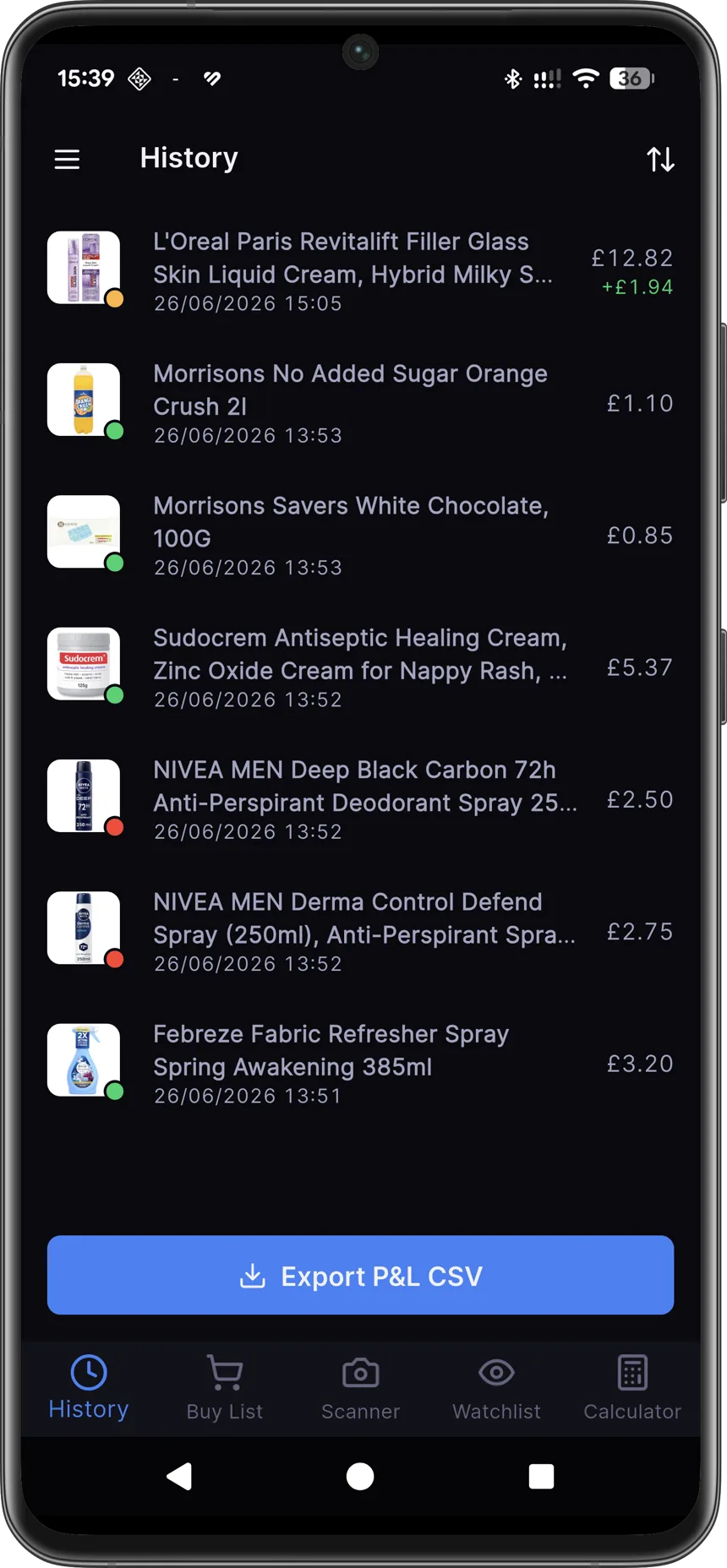
Over a sourcing session the scan history becomes a colour-coded record — green (worth buying), amber (marginal), red (no) — and the products you committed to move to a Buy List with quantities and costs.
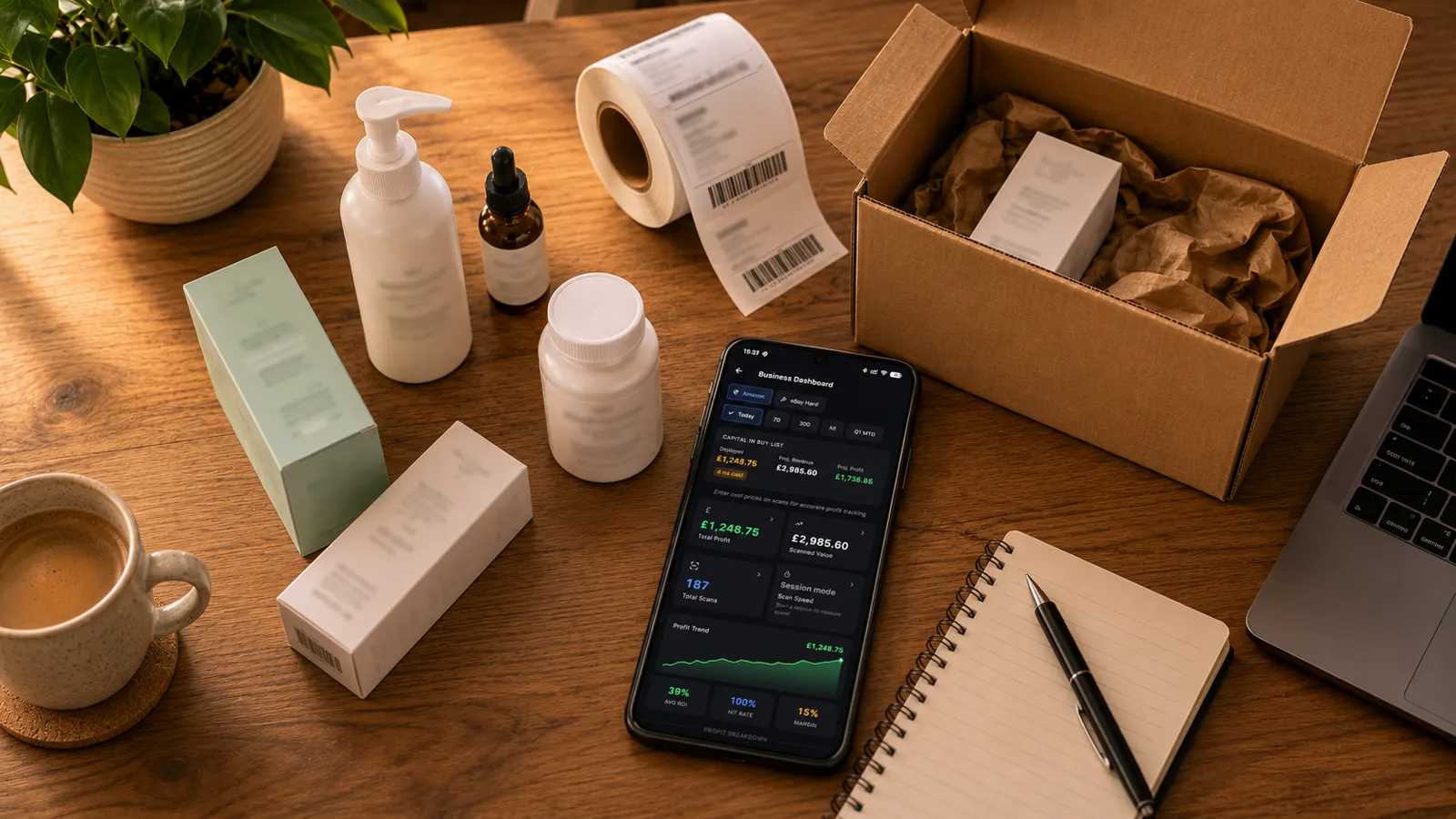
From there the routine is prep, label, box, and ship to an Amazon fulfilment centre, and the dashboard tracks what your scanning is actually producing: profit, average ROI, hit rate. That feedback loop — which shops, which categories, which price points work for me — is how RA sellers get better month over month.
Set your rules once, then follow them
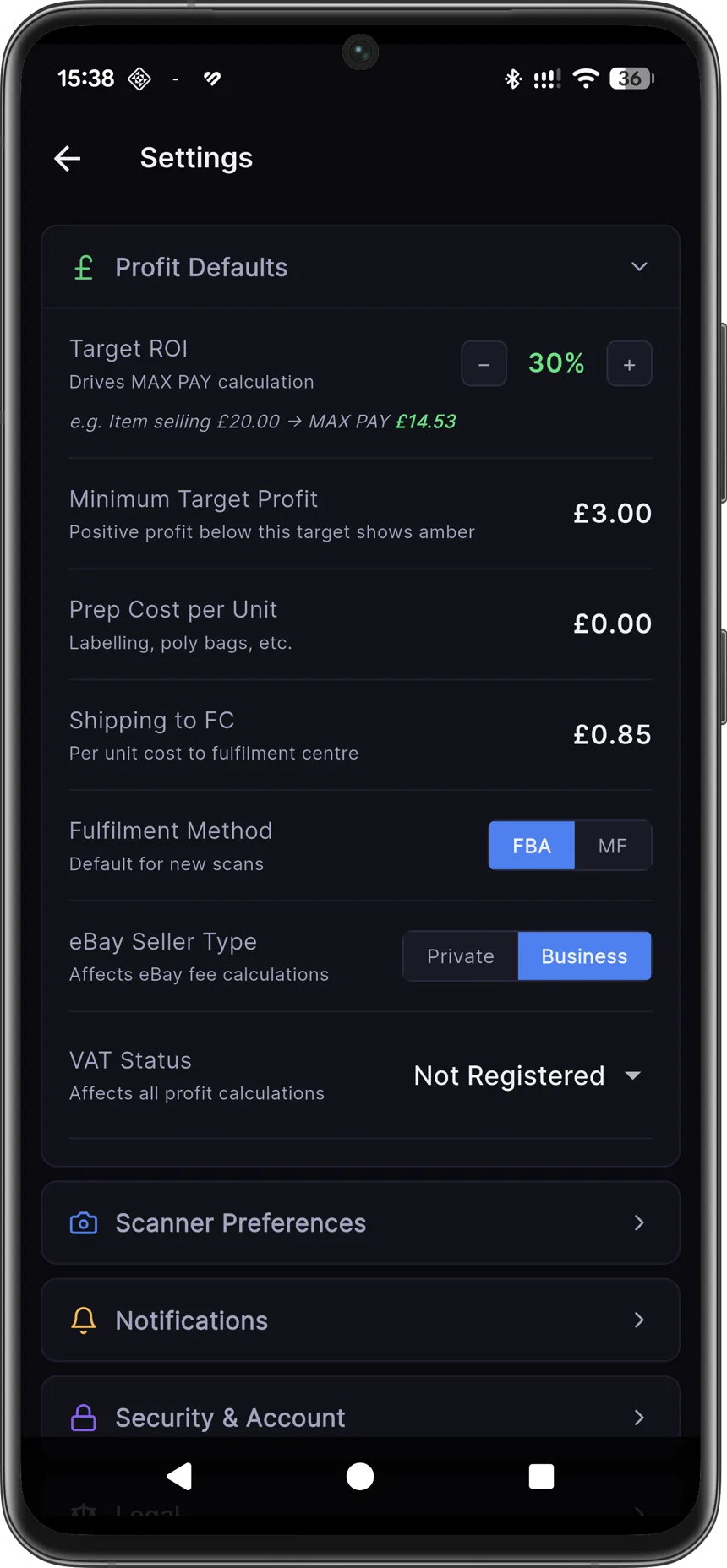
The difference between profitable and unprofitable RA sellers is rarely effort — it's rules. Set a target ROI (30% is a common UK floor), a minimum cash profit per unit (say £3, so small wins aren't eaten by small disasters), include your real costs (prep, shipping to the fulfilment centre), and let every scan be judged against them automatically. Our ROI and BSR benchmarks guide covers how to choose sensible thresholds — and why how fast stock sells matters as much as margin in 2026.
Common beginner mistakes
The same five mistakes account for most beginner losses. Buying on price gap alone — a £5-to-£14 gap means nothing until fees, VAT and competition are subtracted. Ignoring who else is on the listing — 60 sales a month shared between 12 FBA sellers is 5 each. Trusting today's price — always check the 90-day history; buying at the top of a spike is the classic first loss. Over-buying a winner — a product that clears your targets at 5 units can still be a mistake at 50 if it sells through slowly (see sell-through rate). And skipping the gating check — discovering a brand is gated after buying is an avoidable trip to the returns desk. Every one of these is caught by the same habit: run the numbers before the till, every time.
The honest summary
Retail arbitrage is real, legal, and still works in the UK in 2026 — but it's a numbers discipline, not a treasure hunt. The sellers who profit are the ones who check demand, fees, competition and price stability before the till, and who walk away from most products they scan. The maths that used to take ten minutes per product now takes one scan: Axivelo shows net profit, ROI, MAX PAY and the demand signals on one screen, free to start on Android. Prefer to sanity-check a single product at your desk? Use the free UK FBA calculator. And when you're ready to actually begin, the step-by-step starting guide takes it from here.
Run the numbers before the till
Axivelo turns any barcode into net profit, ROI, MAX PAY and demand signals — UK fees and VAT built in. Free to install, 10 scans a day free.
Get Axivelo on Google PlayFAQ
What is retail arbitrage in simple terms?
Buying products cheaply from ordinary shops — usually clearance or promotional stock — and reselling them on Amazon at the higher online price. The profit is the price gap minus Amazon's fees and your costs.
Is retail arbitrage legal in the UK?
Yes. Once a genuine product is sold by the brand or with its consent, the buyer is free to resell it (exhaustion of rights). You must sell genuine goods and describe them accurately, and some brands or categories on Amazon are gated, meaning you need Amazon's approval to list them.
How much money do you need to start retail arbitrage?
Less than almost any other Amazon model. Many UK sellers start with £100–£300 of clearance stock, because each buying decision is only a few pounds. The bigger constraint is discipline: only buying products whose numbers clear your ROI and profit targets.
What's the difference between retail arbitrage and online arbitrage?
Retail arbitrage sources from physical shops; online arbitrage sources the same way from websites. The profit checking — demand, fees, competition, price stability — is identical.
Do I need an app for retail arbitrage?
You need some way to check an item's Amazon price, sales rank, fees and competition before buying — doing it manually with Keepa plus a calculator works but is slow in-store. Scanner apps like Axivelo do the whole check from one barcode scan, which is what makes scanning 50–100 products in a session practical.

UK Amazon FBA sellers — we built Axivelo after one too many trips juggling Keepa, a calculator and a spreadsheet halfway down a B&M aisle. Now it shows profit, ROI, MAX PAY and demand on every in-store scan.